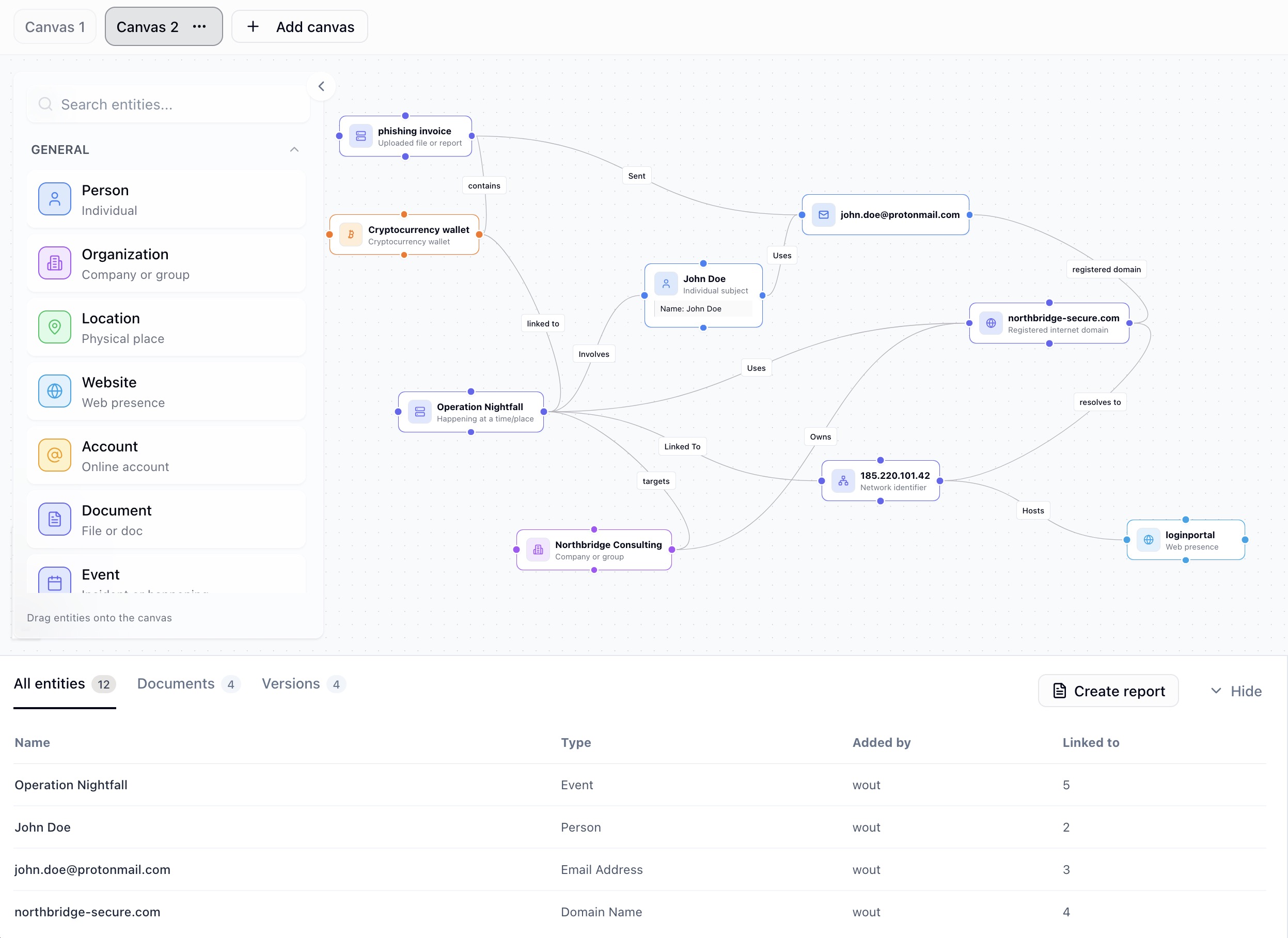
Map networks, connect evidence, and keep the whole case in one view.
Tracehunters is for investigators who need to connect wallets, people, infrastructure, evidence, and chronology without juggling spreadsheets, whiteboards, and scattered documents.

Keep entities, links, evidence, timeline events, and report output in one investigation surface instead of splitting the case across separate tools.
Unlike Excel, Notion, or Miro, the graph, timeline, and evidence model belong to the same case surface.
Split a project into people, companies, sites, or infrastructure canvases without breaking the investigation apart.
Workflow-specific encryption keeps infrastructure access separate from investigation access.
Teams can work in the same case without turning the investigation into disconnected notes and screenshots.
Your investigation lives across five tools?
Put wallets, people, companies, infrastructure, evidence, and events into one live case graph so you stop reconstructing context from tabs, docs, and screenshots.
Cannot explain why two wallets are connected?
Attach links to timeline events and source evidence so a connection is not just visible on screen, but defensible when another analyst reviews the case.
Still using screenshots to explain cases?
Generate reports and controlled views directly from the live case instead of flattening the investigation into static images and ad hoc notes.
Not a note-taking tool. Not a static diagram. A live investigation graph.
The point is not to draw boxes. The point is to keep relationships, chronology, evidence, access controls, and output quality intact as the case gets more complex.
Documents capture conclusions after the fact. They do not hold linked investigative context as the case evolves.
Whiteboards can draw relationships, but they do not preserve chronology, evidence, permissions, or reviewable structure.
Tracehunters keeps links, timeline, evidence, reporting, and access controls in one case surface that evolves with the investigation.
Case graph for real investigations
Model people, wallets, companies, infrastructure, evidence, and events without turning the case into a generic whiteboard.
Multiple canvases in one investigation
Keep one case file while splitting the visual work into dedicated canvases for people, companies, websites, infrastructure, or other subgraphs.
Case-level encryption
Every workflow has its own encryption boundary so platform administration is not the same thing as case access.
Live collaborative analysis
Multiple investigators can work in the same case while preserving structure, evidence context, and shared state.
Reporting from the live case
Turn active case structure into a clean output for stakeholders without rebuilding the narrative in separate tooling.
Add AI review and controlled external access when the case becomes a team workflow.
Pro is where Tracehunters becomes an operational system: reviewable AI proposals, secure share links, and collaboration features that support real investigative teams.
Ask AI for changes, review them before they apply, then share the result without exposing edit access.
The point of the AI layer is not novelty. It helps teams summarize cases, propose links, and update graph structure faster while keeping a human review step in the workflow, including structured organogram edits.
Ask for a case summary, suggested links, or graph edits in plain language.
See proposed changes before they are applied to the live investigation.
Keep the accepted structure in the case and share a cleaner result externally.
Tracehunters AI
Prepare reviewable graph proposals from plain-language instructions, including parent-aware organogram changes on Pro investigations.
Secure external share links
Publish controlled read-only investigation views without exposing editing access.
Investigators should be able to ask for graph changes in plain language, review what will happen, and share findings safely without flattening the investigation into screenshots and ad hoc notes.
Pricing for solo investigations, recurring casework, and team operations.
Start free to test the workflow. Upgrade when you need unlimited investigations, timeline-driven reporting, version history, or team collaboration. All plans are billed monthly and can be changed or canceled from your account.
Ready to build your first investigation?
Create a workflow, map the case visually, and move from exploratory links to structured findings in one place.
Investigation techniques, case design, and analyst field notes.
Learn how investigators structure cases, connect evidence, and turn live analysis into stronger outputs.
Collaborative Investigations: Real-Time Teamwork in Tracehunters
Discover how Tracehunters' new collaborative features revolutionize team-based OSINT investigations with real-time synchronization, team management, and seamless workflow sharing.
Professional OSINT Reports: Automated Intelligence Documentation in Tracehunters
Transform your investigation workflows into professional, comprehensive OSINT reports with Tracehunters' automated report generator - from data extraction to PDF delivery.
Investigation Timeline: Visual Chronology for OSINT Analysis
Master the sequence of events in your investigations with Tracehunters' powerful Timeline feature - visualize chronology, track confidence levels, and build compelling evidence chains with professional timeline layouts.